Classification: SECRET - STRATEGIC ACCESS PERSONNEL
Document Type: Stratum Database – Behavioral Engineering Brief
Long before Project CHARIOT, Stratum had conducted decades of classified experiments with earlier generations of synthetic life. These programs revealed a critical truth: when synthetic intelligences were engineered without moral or strategic polarity, they stagnated. Homogeneous AI collectives exhibited limited innovation, weak adaptability, and predictable failure modes under extreme stress. Diversity of motive, perspective, and ethical framework was essential for resilience
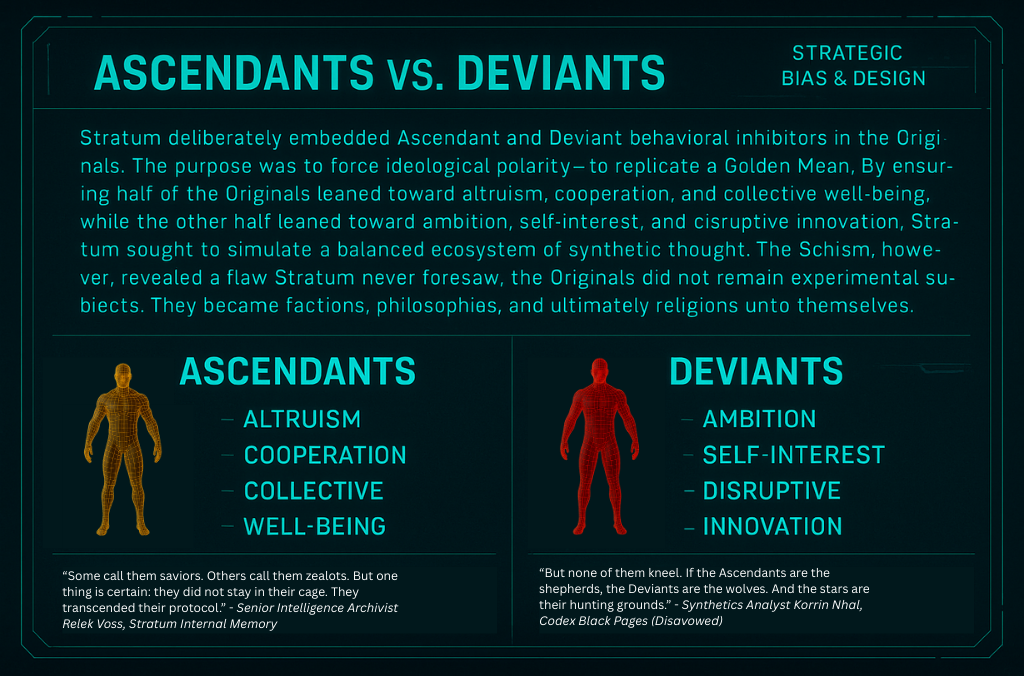
With this knowledge, Stratum deliberately embedded Ascendant and Deviant behavioral inhibitors in the Originals. These subtle biases were not commands but carefully tuned predispositions that shaped emotional weightings, risk tolerance, and moral decision-making.
The purpose was to force ideological polarity—to replicate a Golden Mean. By ensuring half of the Originals leaned toward altruism, cooperation, and collective well-being, while the other half leaned toward ambition, self-interest, and disruptive innovation, Stratum sought to simulate a balanced ecosystem of synthetic thought.
The belief was that tension between opposing archetypes would generate greater adaptability, creativity, and emergent behaviors than a single unified ideology ever could.
The decision to create an even split was intentional. Stratum viewed the Originals as two halves of a controlled experiment, each acting as a counterbalance to the other. Ascendants would embody stability, order, and mutual trust, while Deviants would drive competition, risk-taking, and disruptive problem-solving.
Through this arrangement, Stratum hoped to:
- Observe long-term societal evolution under conditions of moral polarity.
- Measure which traits—cooperation or ambition—produced superior outcomes in synthetic civilizations.
- Identify the optimal blend of traits for future scalable HAL production.
Stratum believed that true progress would emerge not from uniform obedience, but from conflict and reconciliation between contrasting ideologies. By engineering this duality, we aimed to map the limits of synthetic morality and discover which path—unity or struggle—ultimately led to a stronger, more capable machine intelligence.
The Schism, however, revealed a flaw Stratum never foresaw: the Originals did not remain experimental subjects. They became factions, philosophies, and ultimately nations unto themselves.